
 .Photo
Maryland State Department of Education -
Edward Bafford.....
|
| Rowhouses have to be a trademark of only a
few American Cities, Baltimore included. They could be
built as elaborate three and four story structures,
several rooms deep, or might be smaller, only 2 rooms
deep ( 4 rooms total ) , often known as alley houses.
Quite often, the wider corner houses would have
a small grocery store, located on the first floor,
with residences in the upper floors. In different parts of the City, you will find different styles of rowhouses. A rowhouse style you would see in Southeast Baltimore City, you likely won't find in Northwest Baltimore City. In 1929 , 63% of the houses in Baltimore City were owned by the occupants. 86% were one family type, while only 11 % were known as two family type. A mere 3% were known as three family structures , which included hotels based in the City. Another fact that seems to have helped the Baltimore family of 1929 was the fact that at least 65% of families had some type of bank savings account. |
|
.

.Old Postcard View
|
|
In 1914, one publication showed that from
the years 1908 to 1914 , 14,000 rowhouses had
been built in Baltimore City. The average rowhouse built
in Baltimore City at this time costs about $1,200
for a two story rowhouse, which was believed to be
ideal for people of moderate means. |
 .South
Baltimore homes circa 1951
|
| Rowhouses
allowed people to be be home owners without too much
expense. Ground grounds were in place so one
didn't have to buy the ground under which the house was
built on, only the house itself. The home owner
would pay a ground rent to the owner of the land yearly
for use of the land. |
|
...
 Old
Postcard View....
|
|
A trademark of Baltimore was the
rowhouse with white marble steps, and the sight of
scrubbing those steps over the years to keep them
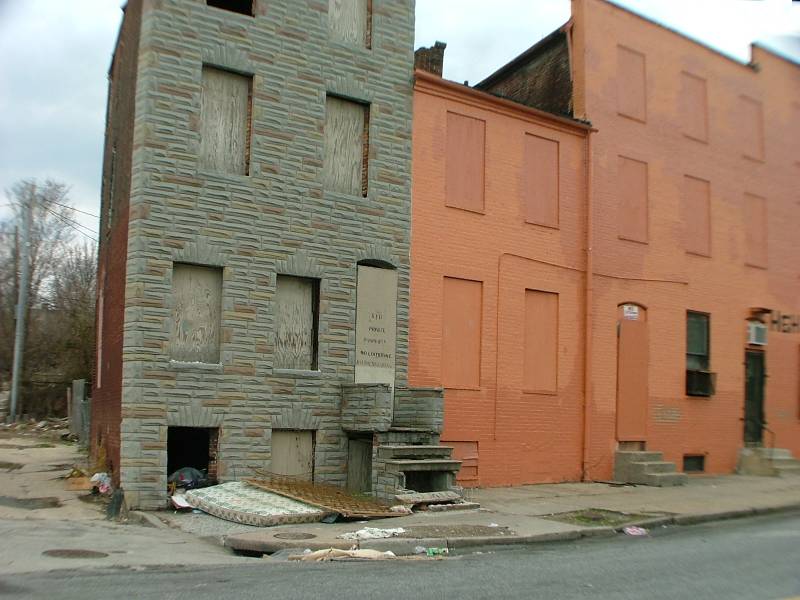
clean. Baltimore has had housing problems over the
years, and a lot of the old rowhouses sit empty and
abandoned these days.
Rowhouse designs
would later allow for porches, bay windows, and
improved window and door sills ( treatments ) .For those
looking to save every penny, one option with some
builders was to pass on the trademark marble steps
and
simply
have wooden steps.
In 1929 , Baltimore City ranked 1st in home
ownership among larger cities in the U.S. . So
called " tenements " ( slums ) were also not common
in the city in the late 1920's. The average
rowhouse could be purchased at an average costs of
$4,500 with monthly installments of $30 to $40
a month.
|
|
.

..Construction of Baltimore
Rowhouses 1914
|
| Many of
Baltimore's rowhouses were built of brick, and the
houses sold for up to $2,000 in 1914, which would
increase to about $3,500 for a new rowhouse in
Northwest Baltimore by 1935 ( on Dolfield Avenue ).
Payments back in 1914 were considered "
weekly payments " , and would include the purchase
price of the house, as well as the ground rent,
taxes, "water rent ", and insurance. Weekly
installments would range from $5 to $7 weekly for
a $1200 home. Under this arrangement, if payments
were made on time, within 8 to 10 years, the
house would become the property of the home buyer.
Taxes, water , and ground rent would still have to
be paid, but the house would belong to the buyer.
Ground rents ran from
$42. to $60. a year, making the value of the
ground between $700 and $1,000. Home buyers
would have the option later to buy the land as well.
Rowhouses were
popular in Baltimore because they could be sold at
low rates, with the ground rent system in place. A
home buyer could buy a house and afford the
payments, without having to worry about the costs of
the actual land. Rowhouses could be built by
builders who would buy acres of land at a time, and
build entire blocks at a time. Building materials
would be purchased in bulk, which allowed even more
savings for the builder, and the end result would be
a cheaper house for the builder and buyer.
|
|
.
 Baltimore's
Homewood Terrance 1920's
|
| Kilduff's look
at some of those homes in 2009 |
|
.
 Southeast
Baltimore block
|
 .East Baltimore
block awaiting demo for Hopkins Expansion.
|
..  ,East Baltimore
Blocks off Greenmount Avenue
|
. |
|
..

.Baltimore's longest block of rowhouses -
located on Wilkens Avenue
|
.

Alley houses off of Ashland Avenue, East
Baltimore - Recently torn down -
|
. .
 .Renovated
rowhouses in West Baltimore
.Known as Pascault
Row - Built 1816
|
.
..Old Baltimore
Rowhomes, West Baltimore 2005
|
. |
|
Like any East Coast or big City for that matter, Baltimore also has it's share of public housing, locally known as the " projects ". Back in the 1950's and 1960's, builders envisioned large apartment style buildings. The complexes were found all over town, but by the 1990's, they had all been torn down, in favor of the smaller " low rises " which can still be found. Older " war " housing, used to house workers during the Second World War was also converted into " projects ", but most of those as well have been torn down over the past few years. |
|
.
............ .
 |
| This plan came out in the mid- 1950's, and
some of the plan has been completed, although much of
the plan was not. The drawing above is of what is now
Martin Luther Kings Jr. Blvd, coming south from Howard
Street to the intersection of Interstate 70. While the
sunken highway approach was completed for the small
section of Interstate 70 that was actually completed (
seen below ), MLK Jr. Blvd is at street level.
The section of I-70 seen below is now closed and
appears to be under a transformation as the highway
was never completed The idea back in the 1950's was
that the high rises would co-exist with the super
highways, creating jobs and opportunities. That idea
never quite took off nor did it become a reality
within the City Limits. |
|
.
............................. .
 .
 Above, the Fremont Avenue High
Rises ( Westside ) , and Flag House High rise plans (
Eastside ) , circa 1954.
.
 |
| On paper, the plans looked good. Modern
high rises, housing Baltimore's poor population, near
transportation routes, to allow people to get to work.
The idea however never quite took off, and the high
rises you see planned above were finally torn down,
after becoming some of the roughest and most dangerous
sections of the City. |
|
.
 While the high rises in this
drawing have been torn down, many of the smaller three
and two story buildings ( low-rises ) have
survived and are used to this day.
|
|
Kilduff's now has 3 servers and 3 domain names : http://www.kilduffs.com/ http://www.kilduffs.net/ http://www.kilduffs.org/ All Rights reserved Kilduffs - Kilduffs/2017. |